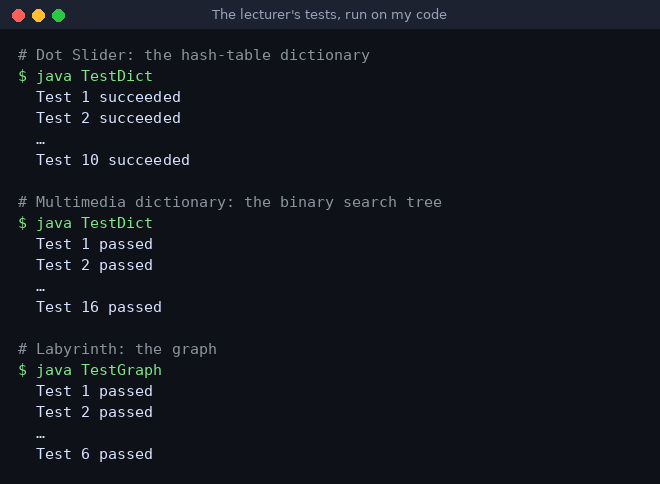
Data Structures and Algorithms (CS 2210) at Western University. In each assignment the lecturer gave us the game windows and the tests, and I wrote the data structures and the logic that make them work. Because those programs are not all my own code, they don’t run on this site. Here is what I built, with screenshots from running them.
Dot Slider: a hash table
A board game against the computer. I wrote the dictionary as a hash table with separate chaining (a list in each slot), with a polynomial hash function over the board layout. It remembers board layouts the computer has already scored, so it never works the same one out twice. I also wrote the board logic: finding a winner in a row, column or diagonal, spotting a draw, and keeping track of the tiles.
Multimedia dictionary: a binary search tree
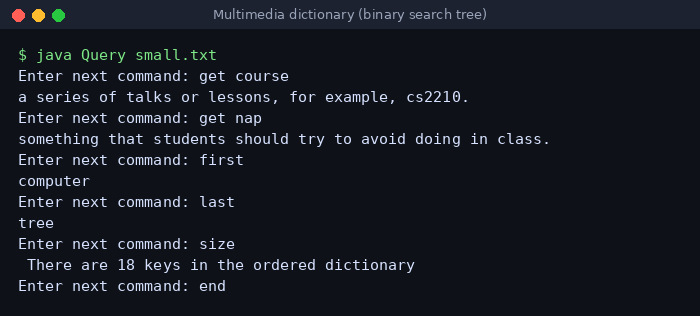
An ordered dictionary of words, kept in a binary search tree, where each word can have text, pictures and sounds. I wrote the tree (add, find and remove a word, the smallest and largest word, the next and previous word) and the program that answers the commands you type.
Labyrinth: a graph
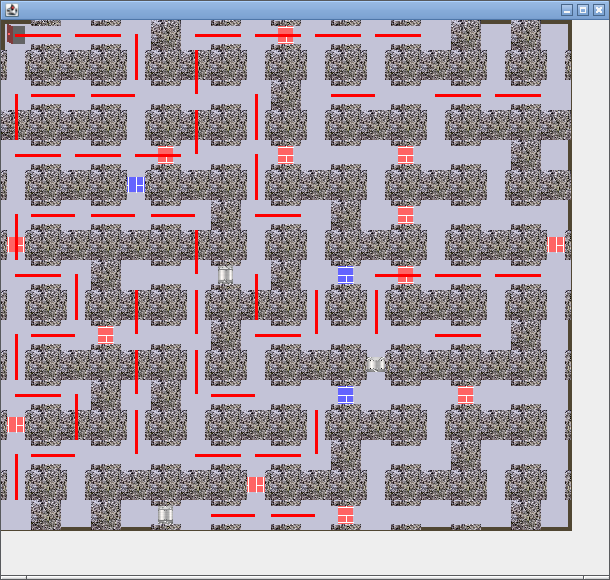
I read a labyrinth from a file into a graph (rooms are nodes, corridors and walls are edges) and wrote a solver that finds a way from the entrance to the exit with a depth-first search. It breaks through brick, rock and metal walls only while it still has the right bombs, and backs up to try another way when a path doesn’t work out.
Smaller exercises
Counting the nodes of a tree that have an odd number of children (recursion), and finding the number that appears most often in an array (a hash map).
The three programs passed the lecturer’s tests: